Custom Instruction Finding with ScaleISA
Discovery, implementation exploration, selection, and the APS ScaleISA driver.
Purpose and motivation
ScaleISA is for application-driven instruction customization: use it when you have computations to accelerate but have not fixed the custom instructions or their hardware implementations. It discovers reusable patterns and chooses a set of implementations under an area budget, connecting instruction identification with hardware design decisions.
Reuse is a semantic property: two program fragments can compute the same function while using different expressions. ISAMORE introduced e-graph anti-unification and pattern vectorization to find reusable, parallel instructions beyond syntactic matching. Its motivating figure shows how equivalent expressions can expose a shared instruction instead of requiring a large instruction that switches between separate implementations.
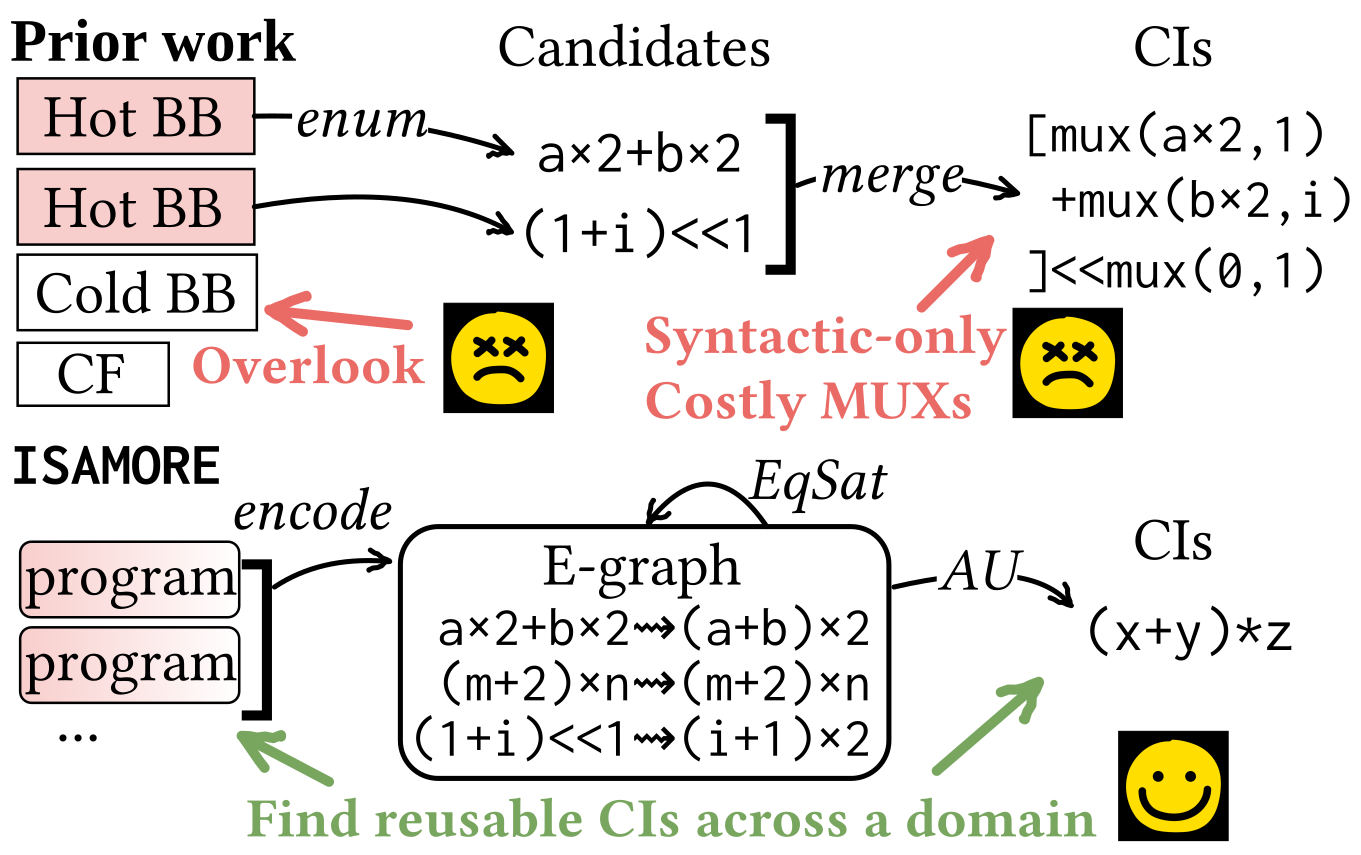
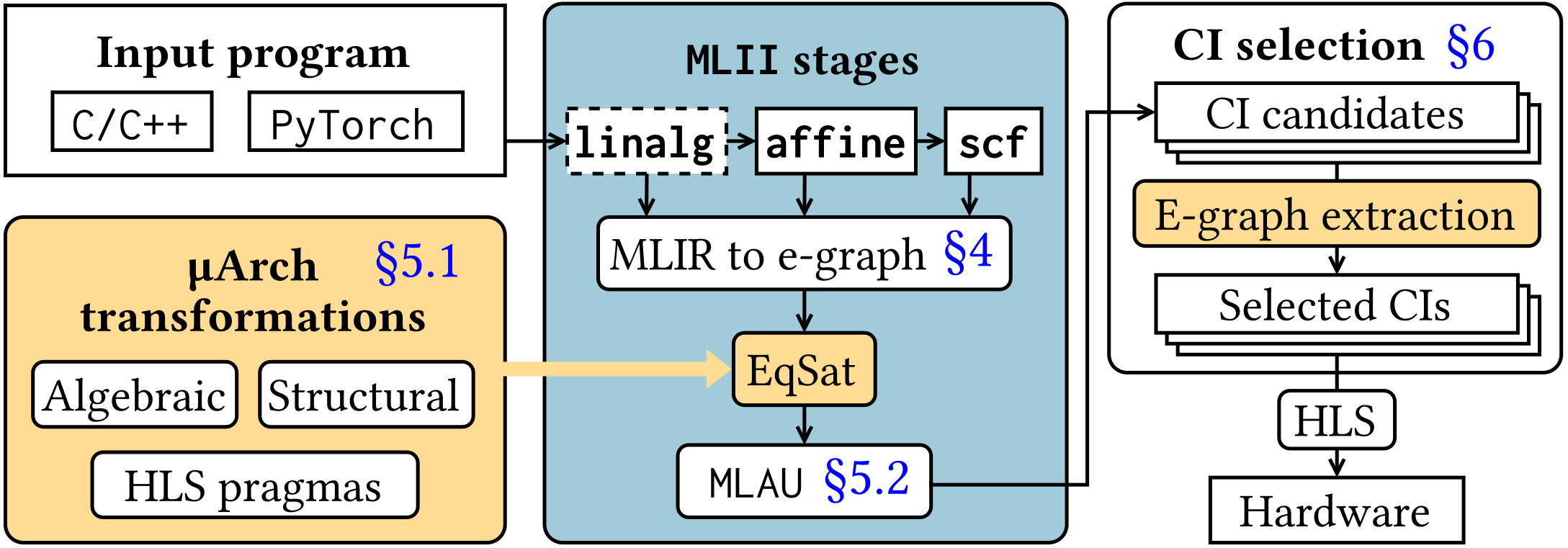
ScaleISA addresses a further issue: lowering code too early can hide reusable loop- or tensor-level computations, while choosing an instruction before exploring its hardware can miss better global tradeoffs. It combines MLIR with e-graphs to preserve opportunities at multiple abstraction levels and considers instruction candidates and microarchitectural implementations in one search space. Its overview shows discovery across structured computation levels, implementation transformations, and final selection.
Discovery and selection
ScaleISA encodes MLIR computations in e-graphs, which retain equivalent alternatives during exploration. Multi-level anti-unification identifies shared patterns; implementation exploration introduces choices such as different loop organizations and hardware parallelism. Selection weighs those alternatives against modeled software cost and hardware area/timing constraints.
The available discovery stages are linalg, affine, and scf. They expose different kinds of structure rather than treating every computation as a low-level instruction sequence. The default APS driver explores all three. The current command-line entry point consumes suitable application MLIR; the paper’s C/C++ and PyTorch inputs refer to the surrounding frontend flow, not direct file inputs to this driver.
ScaleISA and the APS driver
The ScaleISA discovery tool and engine implement instruction exploration. aps-scaleisa-opt is the integrated APS driver: it prepares the target model, runs discovery and selection, adapts selected kernels to the APS hardware contract, synthesizes RTL, and compiles the selected software. It can additionally link a supplied runtime and execute matching hardware/software in co-simulation.
This makes the driver the user-facing entry point for producing an integrated package. You do not need to manually reconstruct the adapter, synthesis, and software-lowering pass sequence.
Inputs and control options
| Input or option | Purpose |
|---|---|
Application .mlir |
Workload suitable for discovery |
--area-budget |
Constraint used during instruction/implementation selection |
--output-dir |
Directory for generated files, reports, and logs |
--discovery-stages |
Discovery levels; default linalg,affine,scf |
--selection-method |
greedy, cbc, or eboost; solver prerequisites depend on the method |
--target-profile |
Software, hardware, and interface model used for exploration |
--resource, --clock |
Resource contracts and scheduling period for APS synthesis |
--verbose |
Stream stage logs |
--timeout |
Per-stage timeout in seconds; default 3600 |
A supplied target profile includes resource contracts, so omit --resource when using --target-profile. Use a consistent target profile when comparing runs. The area and latency quantities used during selection are model estimates, not physical implementation measurements.
Example invocation
pixi run build/tools/aps-scaleisa-opt/aps-scaleisa-opt \
  scaleisa/benchmarks/pcl/octree_search/octree_search.mlir \
  --area-budget 500 --output-dir build/scaleisa-octree
The bundled input supplies a concrete workload; the output directory gathers the whole run. Discovery may take substantial time. Inspect report.json and individual stage logs to see which stages completed and which artifacts were generated.
Outputs and interpretation
| Output | What it provides |
|---|---|
| Discovery and selection reports | Chosen candidates, modeled costs, and selection decisions |
candidates.mlir, planned.mlir, hardware.mlir |
Candidate collection and materialized hardware contracts |
design.sv |
Synthesized accelerator RTL when hardware is selected |
selected.mlir |
Software with the selected instruction sites |
program.o or program.elf |
Compiled software; executable output needs platform linkage |
report.json and stage logs |
Commands, durations, status, metrics, and artifact hashes |
A valid run can select no instructions. In that case the driver emits software without accelerator RTL and reports hardware_selected: false; check the report before treating the run as a generated accelerator.
Reuse, execution, and validation
--discovery-dir=PATH can reuse completed discovery only when the recorded input, target profile, budget, selection method, and discovery stages match. Changing the target model can change which implementations are appropriate.
Object output is the default. To produce an executable, use --emit=elf and supply the intended startup/runtime and linker inputs. --cosim builds and runs the matching Spike + Verilator model for an executable. Software compilation explains linking and compile-only use; Processor integration explains the distinction between functional validation and processor measurements.
Validate accelerated outputs against an independent software reference. Modeled speedup, measured accelerator cycles, and measured processor speedup have different scopes and should be reported separately.